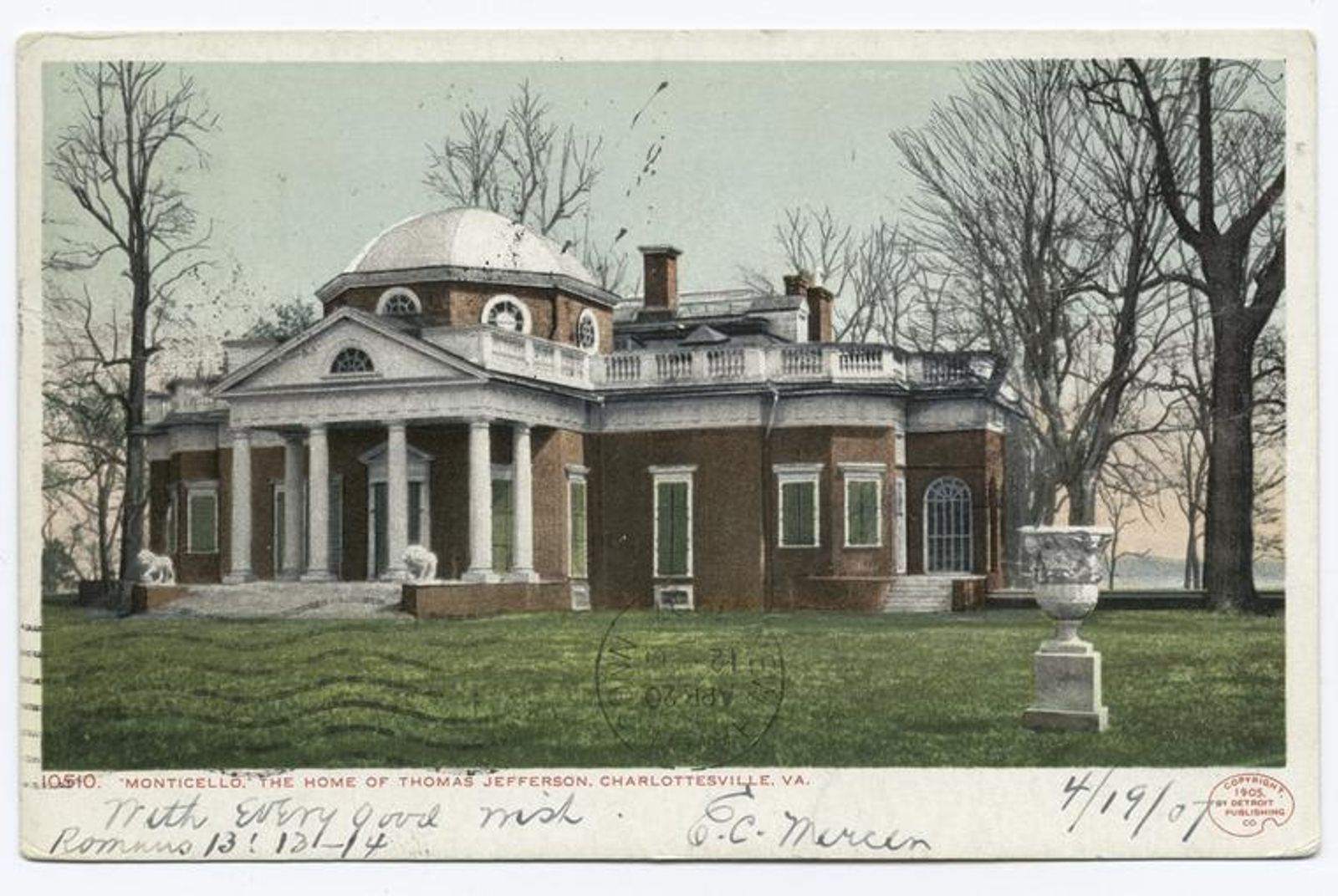
I think often on this, on preservation, from Thomas Jefferson (slave owner) in 1791: “let us save what remains: not by vaults and locks which fence them from the public eye and use”. It’s a well-known, perhaps overused quotation. Jefferson goes on to speak of a solution for preservation that is “a multiplication of copies, as shall place them beyond the reach of accident”. It’s our basic principle, nominally enshrined in LOCKSS: Lots Of Copies Keeps Stuff Safe.
But people often take the multiplication principle here, “store lots of copies”, while ignoring that Jefferson also calls for such “multiplication of copies” to be unfenced: in the “public eye and use”! Jefferson here calls for preserved copies to be visible and usable. In a sense: open.
I have an inkling that another scholar of OA (Peter Suber?) already made this point, and I apologise if so, but I am currently in hospital with a life-threatening infection and my memory is shot. Please do let me know if you know and I will credit that person.
In any case, this steers me to ask whether dark archives can be justified. Yes, we can computationally check checksums and run as many automated tests as we like, but the only way truly to know whether an item remains usable is by actually letting someone use it. If such archives were open and light, it would also give much greater confidence about the preservation status of scholarly materials. At present, we must rely on catalogues that declare ingest, but with no external way of verifying that the archive has what it says it has.
Trad publishers already majorly dislike the decentralisation of repositories, preprint servers, and other mechanisms that divert attention, authority, and metrics away from their central “version of record”. Adding archives would be more fun.
So then, what’s the difference between a preservation archive and a repository? I’d say: storage standards, content verification, self-healing, and certification. Then, even though open to the public eye and use, such material is stored in triplicate distributed form and does well on CRL’s TRAC. Of course, Jefferson wrote of physical, not digital, preservation. Different worlds between then and now. Open to the “public eye” would have meant something else, to him. I suspect “digital open, 2026” means something categorically different to “physical open, 1792”.
I also highlighted, above, the compromised moral position from which Jefferson writes. He’s right on preservation, awful in his actions in life; “owning” other human beings. Are there better, earlier expressions of this principle? This one also has US appeal, though.
References
This reference list has been generated, in many cases, through an automated process and may therefore contain errors or incomplete metadata. It is provided purely as assistance for finding the items mentioned within this post.
- ‘Home of Thomas Jefferson, Monticello, Charlottesville, Va.’, The New York Public Library Digital Collections, The Miriam and Ira D. Wallach Division of Art, Prints and Photographs: Photography Collection, The New York Public Library, 1898 <https://digitalcollections.nypl.org/items/f83dd840-c62e-012f-e53b-58d385a7bc34>
- Jefferson, Thomas, ‘To Ebenezer Hazard’, Founders Online, National Archives, 18 February 1791 <https://founders.archives.gov/documents/Jefferson/01-19-02-0059>
- Home of Thomas Jefferson, Monticello, Charlottesville, Va.. (1898). The New York Public Library Digital Collections. The Miriam and Ira D. Wallach Division of Art, Prints and Photographs: Photography Collection, The New York Public Library. https://digitalcollections.nypl.org/items/f83dd840-c62e-012f-e53b-58d385a7bc34
- Jefferson, T. (1791, February 18). To Ebenezer Hazard. Founders Online. National Archives. https://founders.archives.gov/documents/Jefferson/01-19-02-0059
- “Home of Thomas Jefferson, Monticello, Charlottesville, Va..” 1898. The New York Public Library Digital Collections. The Miriam and Ira D. Wallach Division of Art, Prints and Photographs: Photography Collection, The New York Public Library. https://digitalcollections.nypl.org/items/f83dd840-c62e-012f-e53b-58d385a7bc34
- Jefferson, Thomas. 1791. “To Ebenezer Hazard.” Founders Online, February 18. National Archives. https://founders.archives.gov/documents/Jefferson/01-19-02-0059
 Martin Paul Eve